SKIN COMPATIBILITY

Skin irritations or incompatibility reactions are reactions of the skin when it is sensitive to certain substances or external influences. These can be triggered, for example, by skin care products, environmental factors, or even clothing.

Typical signs are:

  • Redness
  • Itching
  • Burning or tightness
  • Dryness or desquamation
  • Small pimples or skin rash

Skin irritations are usually temporary and often caused by external stimuli such as friction, cold, heat, or aggressive ingredients in cosmetics.

Incompatibility reactions can occur if the skin does not tolerate certain ingredients well – but this is not necessarily an allergy, but rather hypersensitivity.


EXPERTS EXPLAIN

METHOD: SENSORY IRRITATION – BURNING ON THE FACE

To exclude skin irritation and incompatibility due to product applications, so-called stinging tests are carried out.

For this purpose, female study participants who are sensitive to lactic acid are selected. These so-called stingers first receive a facial steam treatment.

The test product as well as a reference product are then applied to one side of the area between the nose and the corner of the mouth. The study participants evaluate the occurrence of sensory discomfort on the face (e.g., burning, stinging) immediately after application and at specified points in time thereafter.

METHOD: ACUTE/CUMULATIVE SKIN IRRITATION – REPEATED PATCH TEST

Certain cosmetic ingredients or formulations – such as soaps – can only cause irritation after repeated use. This can lead to irritant contact dermatitis, i.e. skin irritation, in consumers. The main cause of such irritation is damage to the skin barrier, which often manifests itself in visible redness (erythema). 

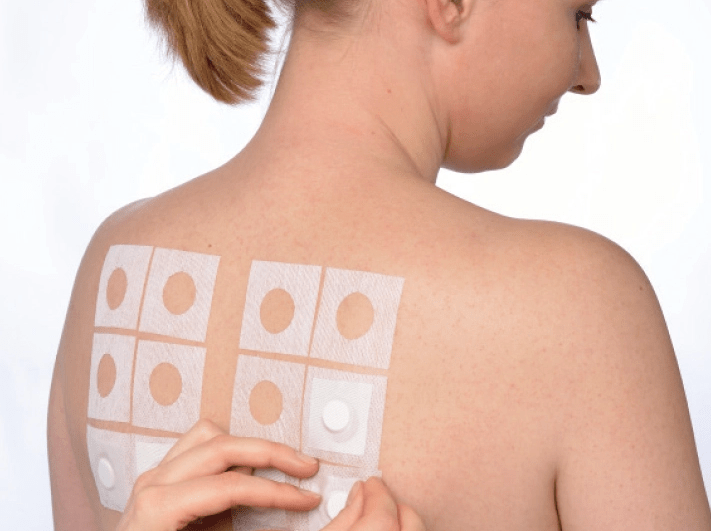
In this study design, we apply a product to be tested to the back using patches over a period of several days. After removing the patches, a clinical assessment of the skin reactions is carried out daily. An irritation index is calculated from these observations.

The aim is to determine the irritation potential of a product or substance through clinical evaluation. An increase in the number and intensity of skin redness – especially during the first few applications – indicates a higher risk of skin irritation such as redness, itching, or burning.