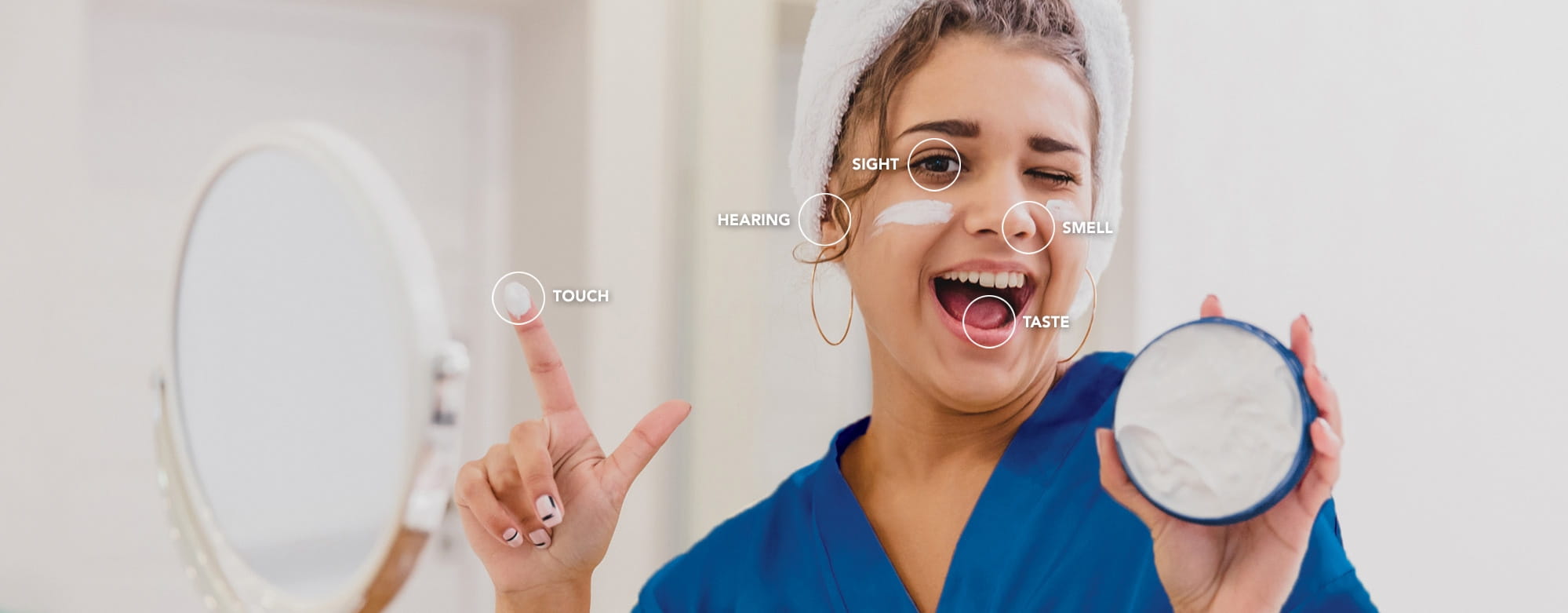
SENSORICS

SENSORICS – Creating the perfect product with all your senses!

Hearing. Seeing. Smelling. Tasting. Touching. 

We test with heart and mind – for products that truly inspire you!

EXPERTS EXPLAIN

… what SENSORICS means to us


Sensorics is an interdisciplinary science that focuses on the perception, description, and evaluation of product properties using the five human senses: sight, smell, taste, hearing, and touch. The aim is to objectively capture and reproducibly describe sensory attributes.

In the cosmetics industry, sensory testing methods are an essential part of product development. They help assess how ingredients influence the perception of product properties and provide insights into consumer opinions — enabling targeted product improvements.

Both descriptive methods (e.g., profile analyses) and discriminative tests (e.g., difference testing) are used:


1. Descriptive Analysis

Trained assessors describe the nature and intensity of the individual product properties to create a detailed sensory profile.

Key questions

How pronounced are the sensory characteristics of a product? How does a new prototype formulation differ from an existing market product, for example?


First, a sensory panel is assembled. Potential panelists undergo selection tests to evaluate their sensory sensitivity and ability to accurately describe product properties. Candidates who meet these criteria then undergo intensive training.

The training aims to familiarize panelists with relevant sensory attributes and the application protocol. This enables them to reliably identify the sensory characteristics of the products and rate their intensity on standardized scales —typically ranging from 0 to 100.

Depending on the project’s objectives and specific requirements, reference standards may be used during training. These serve as benchmarks for certain intensity levels and help calibrate and harmonize panelist’s evaluations.

To eliminate potential influences or biases in sensory evaluation, test samples are presented in neutral containers and anonymized using three-digit random codes. Samples are administered monadically and sequentially according to a balanced rotation plan that ensures randomized order. Each panelist receives a defined, uniform product quantity and evaluates the samples using a specified, standardized application protocol. This ensures consistent testing across all sessions and contributes significantly to the reproducibility of results.

It is also crucial that sensory evaluations take place under controlled conditions. Environmental factors in the test room — especially lighting conditions, room temperature and humidity — are kept constant to minimize external influences on perception and ensure comparability of results.

Collected data are analyzed using statistical methods such as variance analysis and pairwise comparison tests (post-hoc tests) to identify significant differences in sensory dimensions. Results are visualized using line or grid diagrams that clearly illustrate the sensory profiles of the tested product samples.

2. Difference Testing

These tests compare two or more products directly with each other to determine whether there is a perceptible sensory difference.

Key question

Is there a noticeable difference between the products, or are they similar?


A commonly used method is the triangle test, known for its simplicity and time efficiency. Unlike descriptive analysis, it typically requires no extensive pre-training of assessors.

This method is ideal for detecting small sensory differences between product samples and allows for objective statistical evaluation.

Each participant receives three product samples, which are anonymized by random codes. Two are identical, one is different. The arrangement is randomized so that all possible combinations (e.g., AAB, ABA, BAA) occur equally across the sample group — minimizing systematic bias.

Depending on the sensory question and product type, samples are presented either monadically (one after the other) or simultaneously. Assessors are instructed to test all three samples and identify the one that differs from the others.

Data are typically analyzed using a binomial test, which determines whether the number of correct identifications of the deviating sample significantly exceeds the chance level of 33.3%. If the calculated p-value is below the defined significance level (e.g., α = 0.05), a perceptible sensory difference between the product samples can be assumed.

Sensorics: A Key to Product Quality, Customer Satisfaction, and Innovation

The targeted use of sensory panels offers numerous benefits:

Objective Product Evaluation: Sensorics provides measurable and reproducible data on the perceptible product properties — independent of personal preferences.

Quality Assurance: Sensory testing helps detect fluctuations in production early and ensures consistent product quality.

Product Development & Optimization: New formulations or packaging can be specifically tested and refined based on sensory feedback from trained panels.

Competitive Advantage: Products that excel in sensory appeal stand out in the market and strengthen brand loyalty.

Consumer Orientation: Sensorics brings the consumer’s perspective into the lab, ensuring that products not only function well but also impress in in terms of consistency, skin feel, and fragrance.

Marketing Support: Sensory profiles can be used strategically to communicate special product properties.

At the Beiersdorf Study Center, we continuously refine our sensory panels, testing methods, and processes to accurately and practically reflect evolving consumer needs and complex project requirements.

Based on these studies, we develop and confirm claims — i.e. advertising statements —
for our products with the help of our study participants.