EYE WRINKLES

Eye wrinkles are small lines or fine wrinkles that form around the eyes—especially in the thin skin under the eyes or at the outer corners (commonly known as "crow's feet"). They occur naturally due to:

  • Facial expressions: When we laugh, blink, or squint, the skin around the eyes is constantly in motion.
  • Skin aging: Over time, the skin loses elasticity and moisture as the production of collagen and hyaluronic acid decreases.
  • External factors: Sun exposure, stress, lack of sleep, or dry air can further strain the skin.
  • Lifestyle choices: Smoking, poor diet, or insufficient hydration can accelerate skin aging.

Because the skin around the eyes is especially thin and sensitive, signs of aging often appear there earlier than in other areas of the face.

EXPERTS EXPLAIN

Our study designs for eye wrinkles

PRIMOS is used for the examination and documentation of skin microstructure and wrinkles. It enables the quantitative measurement of skin roughness and wrinkles.

The PRIMOS system for contactless wrinkle measurement projects parallel stripe patterns onto the skin. On uneven or wrinkled skin, these stripe patterns appear distorted. A high-resolution camera captures and analyzes these patterns to assess the depth and structure of the wrinkles.

Objective and Personal Skin Evaluation – Your Opinion Matters

In addition to technical measurements, the anti-wrinkle efficacy of cosmetic products can also be assessed through expert evaluations and participant feedback. 

In our efficacy studies, we therefore combine instrumental measurement methods with assessments from experts and participants to gain a comprehensive understanding of the product’s impact on the skin. 

At the same time, study participants receive questionnaires in which they indicate their level of agreement with specific statements about the product properties.

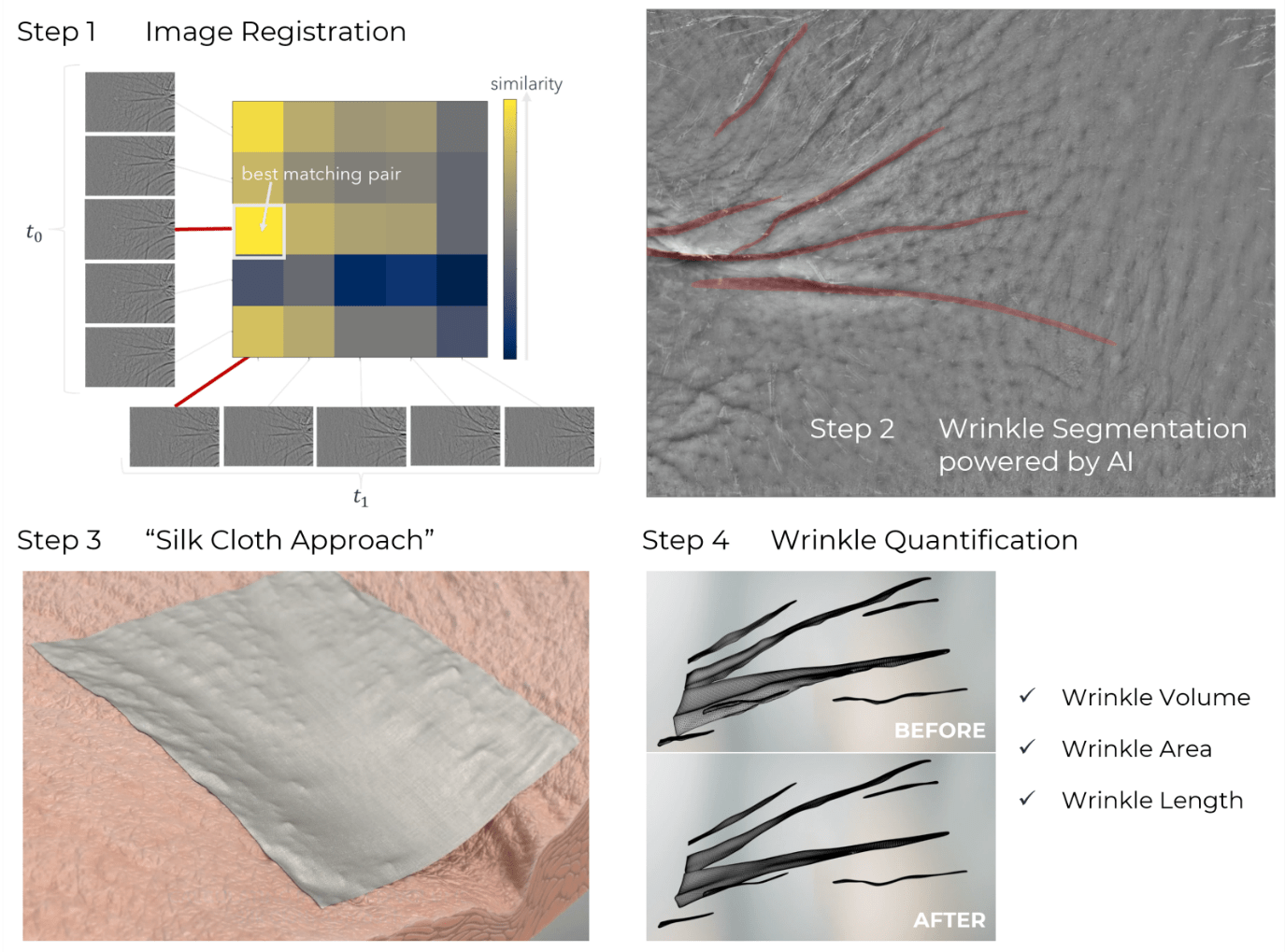
 

AI-Powered Analysis of Eye Wrinkles in PRIMOS Images

Topography maps recorded with our PRIMOS device from the eye wrinkle area are analysed through our in-house analysis pipeline. A key component of this pipeline is an AI model that segments the wrinkles in the images. As a result, in addition to 2D parameters such as the number of wrinkles and the wrinkle area, we can also assess volume changes of the wrinkles in the crow’s feet region.

The analysis pipeline consists of several parts:

  • First, the best matches among repeated measurements at each point in time are identified to minimize the influence of expression-related wrinkles.
  • Then, an AI model segments the wrinkles in the PRIMOS images.
  • This is followed by our so-called “Silk Cloth Approach,” which approximates the exact three-dimensional position of the wrinkles in the topography image.
  • Finally, the wrinkles are quantified in terms of their area, length, and volume.
Figure: Schematic representation of the automated AI-supported analysis of 3D topography images taken from the crow’s feet area of the face using the PRIMOS device as part of clinical studies

Based on these studies, we develop and confirm claims — i.e. advertising statements —
for our products with the help of our study participants.